The ACIC engineer designs, controls and supervises production systems, and organises the flow of data from the sensor up to the company’s business systems. Building on a foundation in electrical engineering (power systems, electronics, power electronics, signal processing), the curriculum develops two complementary areas of expertise: Automatic Control, the science of controlling dynamic systems, and Industrial Computing, which provides the hardware and software to measure, compute, communicate and decide in real time.
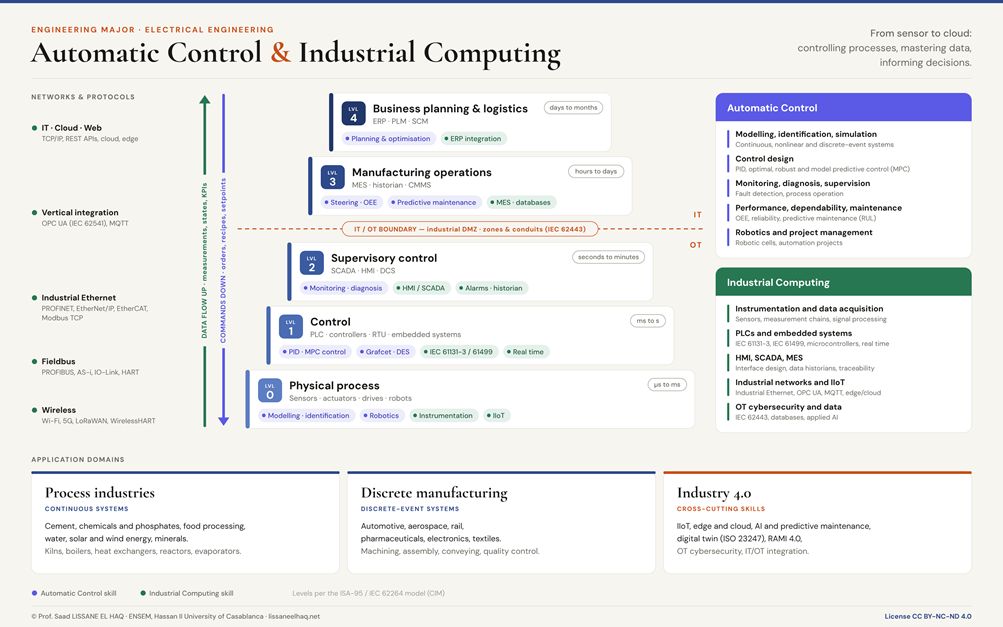
Figure 1 – Where the ACIC engineer fits in the ISA-95 / IEC 62264 automation architecture.
1. Two families of production systems
Continuous systems – process industries
Process variables (temperature, pressure, flow, level, concentration, speed) vary continuously and are regulated in closed loop.
- Sectors: cement, chemicals and phosphate processing, food and beverage, mineral processing, water treatment, power generation (thermal, solar PV, wind)
- Processes and equipment: kilns, boilers, dryers, evaporators, heat exchangers, crystallisers, reactors, columns, tanks
- Energy conversion chains: electrical machines, variable-speed drives, converters and inverters, grid connection of PV and wind plants
Discrete-event systems – discrete manufacturing
The system state changes when events occur (part present, end of cycle, fault); such systems are modelled with Grafcet (IEC 60848), Petri nets and state machines.
- Operations: machining, assembly, welding, conveying, packaging, storage, quality inspection
- Sectors: automotive, aerospace, rail, shipbuilding, electronics, textiles, pharmaceutical packaging
Batch processes. Pharmaceuticals, fine chemicals and food processing combine both natures: sequences of discrete phases with continuous control inside each phase. Recipe-based batch control is standardised by ISA-88 / IEC 61512.
2. Automatic Control
Automatic control studies the dynamic behaviour of systems and designs the control laws that guarantee stability, accuracy, speed of response and robustness. It covers:
- Modelling, identification and simulation: first-principles and black-box models, linear and nonlinear systems, discrete-event systems
- Control design: PID and its variants, state feedback and observers, optimal (LQ), robust (H∞), model predictive (MPC) and nonlinear control
- Design, development and operation of automated production systems: functional analysis, specifications, programming, commissioning and acceptance testing (FAT/SAT)
- Automation project management: planning, cost estimation, coordination with system integrators and maintenance teams
- Monitoring, diagnosis and supervision: fault detection and isolation, process operation, operator decision support
- Performance measurement and steering: production KPIs (OEE, ISO 22400), flow steering and optimisation
- Dependability and maintenance: reliability, availability, functional safety (IEC 61508, IEC 61511, IEC 62061), condition-based and predictive maintenance (remaining useful life, RUL)
- Industrial robotics: geometric and kinematic modelling, robotic cell programming, collaborative robots
3. Industrial Computing
Industrial computing provides the means to collect, process, transmit and use measurements and production data in real time. It covers:
- Instrumentation and data acquisition: sensors and transmitters, signal conditioning and digitisation, calibration
- PLCs and control systems: IEC 61131-3 languages (LD, FBD, ST, SFC), IEC 61499 distributed architectures, distributed control systems (DCS)
- Embedded and real-time systems: microcontrollers, real-time operating systems, determinism constraints
- HMI and SCADA: operator interface design, alarm management (ISA-18.2), data historians and traceability
- Industrial networks: fieldbuses (PROFIBUS, AS-i, IO-Link, HART, CAN), industrial Ethernet (PROFINET, EtherNet/IP, EtherCAT, Modbus TCP), wireless networks (Wi-Fi, 5G, LoRaWAN, WirelessHART)
- Interoperability and vertical integration: OPC UA (IEC 62541), MQTT, MES/ERP exchanges according to ISA-95 (B2MML)
- IIoT, edge and cloud: data collection and storage, databases, dashboards, applied AI
- Industrial cybersecurity: zones and conduits segmentation, industrial DMZ, security levels (IEC 62443 series)
4. The ISA-95 automation architecture
The ISA-95 model (IEC 62264), derived from the CIM pyramid, organises the functions of a manufacturing company into five levels. Commands flow down; measurements, states and KPIs flow up. The ACIC engineer works across all levels, with core expertise in levels 0 to 3.
| Level | Function | Typical systems | Time horizon | Domain |
|---|---|---|---|---|
| 4 | Business planning & logistics | ERP, PLM, SCM | days to months | IT |
| 3 | Manufacturing operations | MES, historian, CMMS, quality management | hours to days | IT |
| IT / OT boundary: industrial DMZ, zones and conduits (IEC 62443) | ||||
| 2 | Supervisory control | SCADA, HMI, DCS | seconds to minutes | OT |
| 1 | Control | PLC, controllers, RTU, embedded systems | ms to s | OT |
| 0 | Physical process | sensors, actuators, drives, robots | µs to ms | OT |
Orders of magnitude of time horizons after the UMH Learning Hub [1]; the IT/OT boundary usually lies between levels 2 and 3.
5. Towards Industry 4.0
Industry 4.0 does not replace automatic control: it connects automated systems and exploits their data. The pyramid is evolving towards networked architectures in which every device publishes its data in a standardised way.
- IIoT, edge and cloud: connected sensors, processing close to the machines, data platforms
- Applied artificial intelligence: predictive maintenance (RUL, LSTM networks), vision-based quality inspection, planning optimisation
- Digital twin: a synchronised representation of a machine or line for simulation and optimisation (ISO 23247 framework)
- Reference architecture: RAMI 4.0 (IEC PAS 63088), combining hierarchy levels, functional layers and life cycle
- OT cybersecurity: essential as soon as the shop floor is connected to the enterprise network and the cloud
6. Careers and sectors
Typical positions
- Control, automation or process control engineer
- Instrumentation and measurement engineer
- SCADA / MES integration engineer, industrial digitalisation and IIoT engineer
- Embedded and real-time systems engineer
- Manufacturing engineering, maintenance and reliability engineer
- Automation or robotics project manager
- Industrial (OT) cybersecurity engineer
- R&D engineer, sales engineer at an automation vendor or system integrator
Growth sectors in Morocco and Africa
The priority sectors identified by Moroccan industrial and education policies recruit these profiles directly [8]:
- Automotive: Africa’s leading vehicle producer, around the Renault (Melloussa) and Stellantis (Kenitra) plants and their suppliers
- Aerospace: more than 142 companies and about 20,000 jobs according to GIMAS
- Renewable energy: Noor Ouarzazate and Noor Midelt complexes, target of more than 52% renewables in the electricity mix by 2030
- Rail: Morocco Rail Plan 2040
- Process industries: phosphates and chemicals, cement, food processing, water and sanitation
- Engineering and services: system integrators, engineering firms, automation vendors, digital transformation consultancies
7. Tools and environments
| Area | Representative tools |
|---|---|
| Modelling and control | MATLAB/Simulink, Python (NumPy, SciPy, python-control), Scilab/Xcos |
| PLCs and control systems | Siemens TIA Portal, Schneider EcoStruxure Control Expert, CODESYS, Rockwell Studio 5000 |
| Supervision, HMI, MES | WinCC, AVEVA, Ignition, Node-RED |
| Production simulation | Arena, FlexSim, Factory I/O, digital twins |
| Data and AI | Python (pandas, scikit-learn, TensorFlow/PyTorch), SQL and time-series databases |
8. Key standards
| Standard | Scope |
|---|---|
| ISA-95 / IEC 62264 | Enterprise–control system integration, levels 0 to 4 |
| ISA-88 / IEC 61512 | Batch control |
| IEC 60848 | GRAFCET specification language |
| IEC 61131-3 | PLC programming languages |
| IEC 61499 | Function blocks for distributed control |
| IEC 62541 | OPC UA, device interoperability |
| IEC 62443 | Security for industrial automation and control systems |
| IEC 61508 / 61511 / 62061 | Functional safety (generic, process, machinery) |
| ISO 22400 | KPIs for manufacturing operations management |
| ISO 23247 | Digital twin framework for manufacturing |
| IEC PAS 63088 | RAMI 4.0, Industry 4.0 reference architecture |
Learn more
Introductory versions of the Automatic Control and Industrial Computing courses are available free of charge at lissaneelhaq.net/enseignement. The full courses (videos, solved labs, projects) are offered on online learning platforms.
References
- UMH, “Automation pyramid”, Learning Hub – https://learn.umh.app/know/operational-technology/automation-pyramid
- CODRA, “MES software and ISA-95: what the CIM pyramid really imposes on industrial architecture”, 2026 – https://codra.net/en/news/2026/07/mes-software-and-isa-95-what-the-cim-pyramid-really-imposes-on-industrial-architecture/
- IEC, IEC PAS 63088:2017 – Smart manufacturing – RAMI 4.0 – https://webstore.iec.ch/publication/30082
- ISO, ISO 23247 – Digital twin framework for manufacturing – https://www.iso.org/standard/87425.html
- OPC Foundation, “Interoperability of the new generation” – https://opcfoundation.org/?p=2593
- Schneider Electric, “La norme IEC 61499 est-elle le chaînon manquant pour l’industrie 4.0 ?” (in French), 2020 – https://blog.se.com/fr/industrie/2020/05/25/la-norme-iec-61499-est-elle-le-chainon-manquant-pour-lindustrie-4-0
- Trout Software, “IEC 62443 zones and conduits explained” – https://www.trout.software/blog/iec-62443-zones-and-conduits-explained
TelQuel, “Secteurs industriels : comment le Maroc prépare les compétences de demain” (in French), 20 Sept. 2024 – https://telquel.ma/2024/09/20/secteurs-industriels-comment-le-maroc-prepare-les-competences-de-demain_1894809